
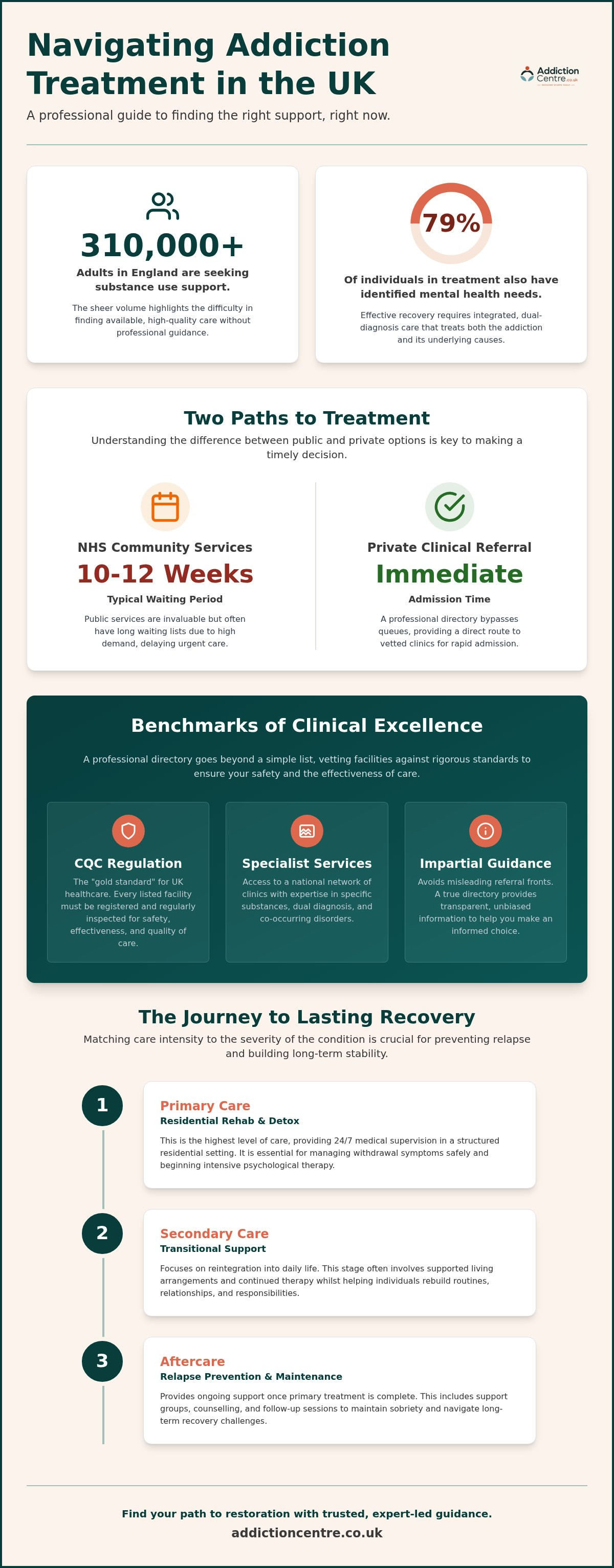
With over 310,000 adults in England now seeking support for substance use, the challenge isn't just finding help; it's finding the right help. You're likely feeling the weight of this urgency right now, perhaps overwhelmed by a sea of generic search results or worried about the quality of care behind a shiny website. It's exhausting to face NHS waiting lists that can stretch for months when every day feels like a crisis. Our expert-led addiction treatment directory and referral framework are designed to cut through that noise, offering you a direct path to safety and clinical excellence.
We understand that choosing a recovery path is one of the most significant decisions you'll ever make. You deserve more than a list of names; you need a professional compass to help you distinguish between a standard detox and a comprehensive residential rehab programme. This guide provides a clear route to immediate admission at CQC-regulated facilities across the UK. We'll show you how to move from a state of uncertainty toward a structured, professional environment where your restoration is the priority.
Key Takeaways
- Discover how a professionally curated addiction treatment directory serves as a vital clinical map, helping you find specialist recovery services that may not be available in your local area.
- Learn why matching the category of care to the severity of your condition is essential for ensuring your chosen facility provides the right level of medical and psychological support.
- Understand the critical benchmarks for evaluating clinics, from CQC regulation to clinical staffing ratios, ensuring your path to restoration is safe and reliable.
- Explore how an impartial referral service narrows down thousands of listings to provide a clear, personalised route to immediate admission and expert-led care.
- Gain clarity on the transition from an initial search to a confidential assessment, providing you with a steady guide through the complexities of the UK recovery landscape.
Understanding the UK Addiction Treatment Directory in 2026
An addiction treatment directory serves as a curated database of clinical facilities, acting as a vital map for those seeking a way out of dependency. A treatment directory is a professional resource for identifying regulated recovery facilities. Whilst many people initially look to their local GP for help, local community teams are often stretched thin and may lack the specific clinical specialism required for certain substances or co-occurring disorders. By looking at a national level, you gain access to a wider range of expertise that can be tailored to your unique history and medical needs.
In 2026, we've seen a significant shift toward integrated directories. This change reflects the reality that substance use rarely exists in isolation; recent data shows that roughly 79% of individuals in the non-opiate and alcohol treatment group also have identified mental health needs. Consequently, a modern directory isn't just a list of names; it's a gateway to drug rehabilitation services that provide holistic, dual-diagnosis support. This integration ensures that when you search for help, you're finding clinics equipped to treat both the physical addiction and the underlying psychological triggers simultaneously.
The Role of CQC Regulation in Directory Listings
The Care Quality Commission (CQC) remains the gold standard for evaluating UK healthcare providers. Every reputable facility in a professional directory must be registered and regularly inspected by this body. You can verify a clinic's standing by checking their latest inspection report, which provides transparent insights into their safety, effectiveness, and leadership. Using unverified or non-regulated lists found online is risky. The Advertising Standards Authority (ASA) has previously taken action against misleading directories that were merely referral fronts for specific parent companies rather than impartial resources. We prioritise transparency so you can choose with confidence, ensuring every listing meets rigorous clinical benchmarks.
Private vs. NHS Services in the UK Recovery Landscape
Understanding the difference between state-funded community services and private residential clinics is vital for managing your expectations. NHS services are invaluable but often face immense pressure, with general waiting lists reaching 7.28 million cases as of May 2026. If your situation requires immediate intervention, a private directory becomes your most effective tool. These resources allow you to skip the 10 to 12-week wait times often seen in the public sector, facilitating rapid admission to either a residential drug detox or a full-term rehab programme. Whether you need a short-term clinical detox or a comprehensive psychological recovery plan, the directory helps you find the right level of care without the delay that so often compromises the window of willingness to seek help.
Key Categories Within a Professional Treatment Directory
A professional addiction treatment directory functions as a sophisticated clinical map rather than a simple contact list. It organises facilities by the intensity of care they provide, allowing you to match the level of intervention to the specific severity of your addiction. This precision is vital. Choosing a facility that lacks the necessary clinical depth for your specific needs can lead to a "revolving door" of treatment, where symptoms are temporarily managed but the underlying condition remains unaddressed. By categorising clinics, a directory ensures you can identify whether you require primary care, which involves intensive residential treatment, or secondary care focused on transitional support and reintegration.
The structure of a directory also helps you look beyond the immediate crisis toward long-term stability. Aftercare providers are a distinct category, offering the maintenance support necessary to prevent relapse once you leave a clinical setting. This methodical approach to categorisation transforms a broad search into a targeted recovery strategy. It allows you to see the full spectrum of the UK recovery landscape, ensuring no stage of your journey is left to chance. If you feel overwhelmed by these choices, a confidential recovery consultation can help you determine which category of care best aligns with your personal history.
Residential Rehab and Detox Centres
For many individuals, the journey toward restoration begins with a clinical detox. This is a high-intensity category that focuses on physical safety during the most vulnerable stage of withdrawal. Finding a reputable provider for residential alcohol detox UK is often the first priority for those facing severe physical dependency. These facilities require 24/7 medical supervision to manage potentially dangerous withdrawal symptoms. Similarly, a residential drug detox requires specific clinical staffing, including doctors and psychiatric nurses who can administer pharmacological support. A directory helps you identify which centres have these medical teams on-site, providing a level of safety that community-based services often cannot match.
Specialist Mental Health and Dual Diagnosis Facilities
Recovery is rarely just about the substance itself; it's often about the psychological "why" behind the use. High-quality directories now prioritise filters for dual diagnosis treatment UK, acknowledging that mental health conditions like depression or anxiety must be treated alongside addiction behaviours. This integrated approach is a global standard for excellence, mirrored by international resources such as SAMHSA's FindTreatment.gov. By selecting a facility that specialises in co-occurring disorders, you're addressing the root causes of dependency. This dual-track focus is critical for long-term success, as it provides you with the psychological tools needed to navigate life's challenges without returning to old coping mechanisms. Treating the mind and body together creates a more resilient foundation for your future.
How to Evaluate Clinics Using an Addiction Treatment Directory
When you use an addiction treatment directory, you're looking for more than just a geographic match. You're looking for a clinical environment where your recovery can actually take root. A directory listing should provide enough transparent data to help you move beyond the surface level. It's essential to look for specific markers of quality that distinguish a premier facility from a standard one. Clinical staffing ratios are a primary indicator of this quality; a high ratio of medical professionals to patients typically ensures you receive the personalised attention required during the more intensive stages of withdrawal and therapy.
The therapeutic models described in a clinic's profile also deserve your scrutiny. Most reputable UK centres utilise a blend of evidence-based practices, such as Cognitive Behavioural Therapy (CBT) or the 12-step model, alongside holistic approaches like mindfulness or nutritional support. This multi-faceted strategy is a hallmark of modern care, similar to the standards used by SAMHSA's treatment facility locator to identify high-quality providers. By understanding the methodology a clinic employs, you can determine if their philosophy aligns with your personal values and recovery goals. The three most critical factors for any effective recovery journey are robust regulation, clinical specialism, and a comprehensive aftercare plan.
You should also examine the "fine print" regarding success rates and aftercare. Be cautious of facilities that promise guaranteed results; instead, look for those that provide transparent completion rates and detailed descriptions of their long-term support systems. A listing that outlines a structured aftercare programme indicates that the facility is invested in your life after you leave their doors. This level of detail helps you verify that the clinic isn't just offering a temporary fix, but a sustainable path toward lasting health.
Analysing Treatment Costs and Financial Options
Understanding the financial aspect of recovery is a common concern for many families. A comprehensive directory helps you understand the various methods for paying for rehab in the UK, including identifying clinics that accept private health insurance from providers like Bupa or AXA. Whilst the private rehab cost UK varies significantly based on the duration of stay and the level of luxury, many facilities offer flexible payment plans to make care more accessible. Identifying these options early in your search allows you to focus on the clinical suitability of a centre without the added stress of financial uncertainty.
Location and Accessibility Considerations
Choosing between a local facility and one further afield is a deeply personal decision. Staying local allows for easier family involvement and visiting, which can be a significant source of strength. However, many people find that travelling for residential treatment provides a necessary "fresh start" away from the people, places, and triggers that fuelled their addiction. A directory allows you to filter by location whilst also checking for transport links and family visiting policies. This flexibility ensures you can choose an environment that feels safe and supportive, regardless of its distance from home.
Navigating the Path from Directory Search to Clinical Referral
Whilst an addiction treatment directory provides the necessary framework for your search, it's often just the first step in a much larger journey. You may find yourself looking at dozens of high-quality listings, each offering different specialisms and therapeutic environments. The challenge then becomes narrowing these choices down to the one facility that truly fits your clinical profile. This is where the transition from data to action happens. By utilising a professional referral framework, you can move from a broad search to a specific admission plan with speed and precision. In many cases, the timeline from your initial directory search to entering a clinic is remarkably short, often occurring within 24 to 48 hours.
This rapid progression is essential when you're in a state of crisis. When the window of willingness to accept help opens, it's vital to have a clear route toward a solution. A confidential assessment turns the abstract information found in a directory into a concrete, personalised recovery plan. This process ensures that you aren't just choosing a clinic based on its location or appearance, but on its ability to meet your specific medical and psychological requirements. If you're ready to take that next step, speaking with an impartial referral service can provide the clarity you need to move forward with confidence.
The Value of Expert Recovery Consultations
Speaking to a recovery specialist is a safer and more effective approach than attempting to self-diagnose via a directory alone. A professional consultation helps identify the appropriate level of care, whether that's a targeted residential drug detox or a full-term rehab programme. We understand that the first phone call can be a source of significant anxiety. Our advisors meet that anxiety with professional empathy, acting as a steady guide in the storm. They help you process the clinical data whilst ensuring your dignity and personal preferences remain at the forefront of every recommendation.
Helping a Loved One: Directory Use for Families
Families often use a directory as a tool to prepare for a difficult but necessary intervention. It provides the factual evidence needed to show a loved one that professional, regulated help is available and accessible. Many families reach out whilst asking can you force someone into rehab in the UK? to understand the legal and ethical boundaries of support. Whilst you cannot typically compel an adult into treatment, you can use directory listings to find family-specific support programmes. these services are designed to help you navigate your own recovery journey whilst your loved one begins theirs, ensuring the whole family unit has the tools to heal together.
Accessing Personalised Support via Addiction Centre
Searching through an addiction treatment directory is a powerful act of agency, but it's often the clinical interpretation of that data where true progress begins. We act as the vital bridge between a broad list of facilities and the specific clinic that will facilitate your recovery. Whilst a directory gives you the "where," our referral service provides the "why" and the "how." We transform a complex database into a manageable, human-centred journey, ensuring you don't have to carry the burden of clinical vetting alone. Our role is to provide the steady hand and professional insight needed to move from a state of research into a state of active restoration.
The advice we provide is rooted in absolute impartiality. We aren't here to push you toward a specific provider; we're here to find the provider that aligns with your medical history, psychological needs, and personal circumstances. This confidential referral process simplifies what can often feel like an insurmountable task. By handling the clinical logistics and initial assessments, we allow you to focus your energy where it matters most: on your health and your future. You deserve a recovery path that is as unique as your own story, and we're committed to helping you find it.
Our Network of Recognised UK Clinics
Every facility featured in our addiction treatment directory has undergone a rigorous selection process. We don't just look for basic registration; we ensure every partner meets national clinical and safety requirements that align with our high standards of care. This network covers a vast breadth of specialisms, ensuring that whether you're seeking help for gambling, opiate addiction, or complex alcohol dependency, there's a dedicated environment ready to receive you. We maintain constant communication with our partners to verify their current CQC standing and clinical staffing levels, providing you with a layer of safety that manual browsing simply cannot guarantee.
Start Your Recovery Journey Today
The transition from uncertainty to clarity can begin right now. You can access our confidential online self-assessment to start identifying your needs in a safe, non-judgmental space. Whilst manual directory browsing is a helpful starting point, it can lead to information fatigue and delay the start of your treatment. Choosing immediate expert guidance ensures that you're matched with a facility that has the current capacity and the specific expertise to help you succeed. Don't let the complexity of the landscape hold you back from the life you deserve. Contact Addiction Centre for a confidential consultation and personalised referral, and let us help you take that first, most important step toward a lasting recovery.
Your Path to Lasting Restoration
Finding the right support is a journey that begins with the right information. We've explored how a professional addiction treatment directory serves as a vital clinical map, helping you distinguish between standard care and the specialised, CQC-regulated environments your recovery requires. You now understand that the most effective path involves matching your specific medical needs with a facility's clinical staffing and therapeutic models. This clarity is the foundation upon which your new life will be built.
You don't have to navigate these complex choices alone. Our network of recognised UK clinics is backed by impartial advice from addiction experts who are dedicated to your restoration. Whether you're seeking a residential drug detox or a dual-diagnosis programme, we provide the steady guidance needed to move from research into active healing. Our confidential assessments are available 24/7 to ensure you have support whenever you're ready to reach out. Start your recovery journey with a confidential consultation today. There is a life beyond dependency, and it's closer than it feels right now.
Frequently Asked Questions
What is an addiction treatment directory and how does it work?
An addiction treatment directory is a professionally curated database designed to help individuals identify and compare regulated recovery facilities across the UK. It works by categorising clinics based on their clinical specialisms, geographic location, and the intensity of care provided, such as residential detox or full rehab. This resource allows you to filter through thousands of options to find a facility that aligns with your specific medical and psychological requirements for a safer recovery.
How do I know if a rehab clinic in a directory is reputable?
You can verify a clinic's reputation by checking its current registration status with the Care Quality Commission (CQC), which is the independent regulator of health and social care in England. Reputable listings will also provide transparent information regarding their clinical staffing ratios and the evidence-based therapeutic models they employ. High-quality directories vet their partners to ensure they meet these national safety standards, providing you with peace of mind during a high-stress period.
Can I find NHS-funded treatment in a private addiction directory?
Whilst some directories may list local community drug and alcohol teams, they are primarily designed to help you navigate private residential options for immediate admission. NHS-funded treatment typically requires a referral through your GP or local authority, which can involve significant waiting times. A private directory is most effective when you're looking for rapid access to clinical services that may not be available through state-funded community programmes at the point of crisis.
How much does it cost to use an addiction referral service in the UK?
Using an addiction referral service to find a clinic is typically a free resource for the individual seeking help or their family. These services are designed to remove the financial barrier to accessing professional guidance, allowing you to receive an impartial assessment without an upfront cost. Whilst the treatment facilities themselves will have their own fees for residential stays, the initial consultation and directory search are provided to help you make an informed clinical choice.
Is my search through an addiction treatment directory confidential?
Yes, your search and any subsequent consultations are handled with the strictest clinical confidentiality. Professional services adhere to rigorous data protection standards, ensuring that your personal information is never shared without your explicit consent. This privacy is a fundamental part of the recovery process, designed to protect your dignity and provide a safe environment where you can explore your treatment options without the fear of judgement or exposure.
What is the difference between a rehab directory and a referral service?
A rehab directory is a static database that lists various facilities, whilst a referral service acts as an active bridge between you and the right clinic. The referral process includes a professional assessment to determine your clinical needs, helping you move beyond a simple list to a personalised recovery plan. Whilst an addiction treatment directory provides the raw data, the referral service offers the expert interpretation needed to ensure you're admitted to the most suitable environment.
How quickly can I be admitted to a clinic found in your directory?
Admission to a private residential facility can often be arranged within 24 to 48 hours of your initial enquiry. This rapid response is a primary benefit of using a professional directory and referral framework, as it bypasses the lengthy waiting lists often found in the public sector. Once a confidential assessment is completed and a suitable clinic is identified, the admission process is streamlined to ensure you receive help whilst your motivation for recovery is at its peak.
Do UK addiction directories include help for mental health conditions?
Yes, many high-quality directories now prioritise facilities that offer integrated support for co-occurring mental health conditions, often referred to as dual diagnosis treatment. Since a high percentage of individuals facing addiction also struggle with anxiety, depression, or trauma, finding a clinic that treats both is essential. These listings help you identify centres with the psychiatric expertise required to address the root psychological causes of dependency alongside the physical symptoms of substance use.


