
What if the greatest barrier to your recovery isn't the addiction itself, but the fear that someone might find out you're looking for help? For many professionals and families across the country, the weight of potential stigma feels just as heavy as the substance use itself. It's natural to feel overwhelmed by the complexity of NHS waiting lists or the sheer volume of private clinics appearing in your search results. You want a path toward healing, but you need to know that your dignity and privacy will remain entirely intact throughout the process.
This article provides the confidential addiction advice UK residents require to navigate the recovery landscape with total discretion. You'll discover how to access expert-led support and identify the premier treatment options that align with your specific clinical needs. We'll explore the various levels of care available in 2026, including residential detox and specialist rehabilitation programmes. By the end of this guide, you'll understand how to utilise a verified directory of centres and see how a professional recovery consultation can act as a steady, quiet bridge between your current uncertainty and a structured environment for health.
Key Takeaways
- Understand how a discreet, clinical environment provides the necessary safe space to protect your professional life whilst you focus on healing.
- Discover how to access confidential addiction advice UK through expert-led consultations that prioritise your unique history over a generic approach.
- Evaluate the 2026 reality of NHS waiting times against the immediate, comprehensive care available within private residential detox and rehab facilities.
- Learn to navigate a national directory to find specialised support for alcohol, drugs, or gambling that may be located outside your immediate local area.
- Identify the clear, methodical steps required to move from the confusion of crisis toward a structured and sustainable recovery path.
Why Confidentiality is the Foundation of Addiction Recovery
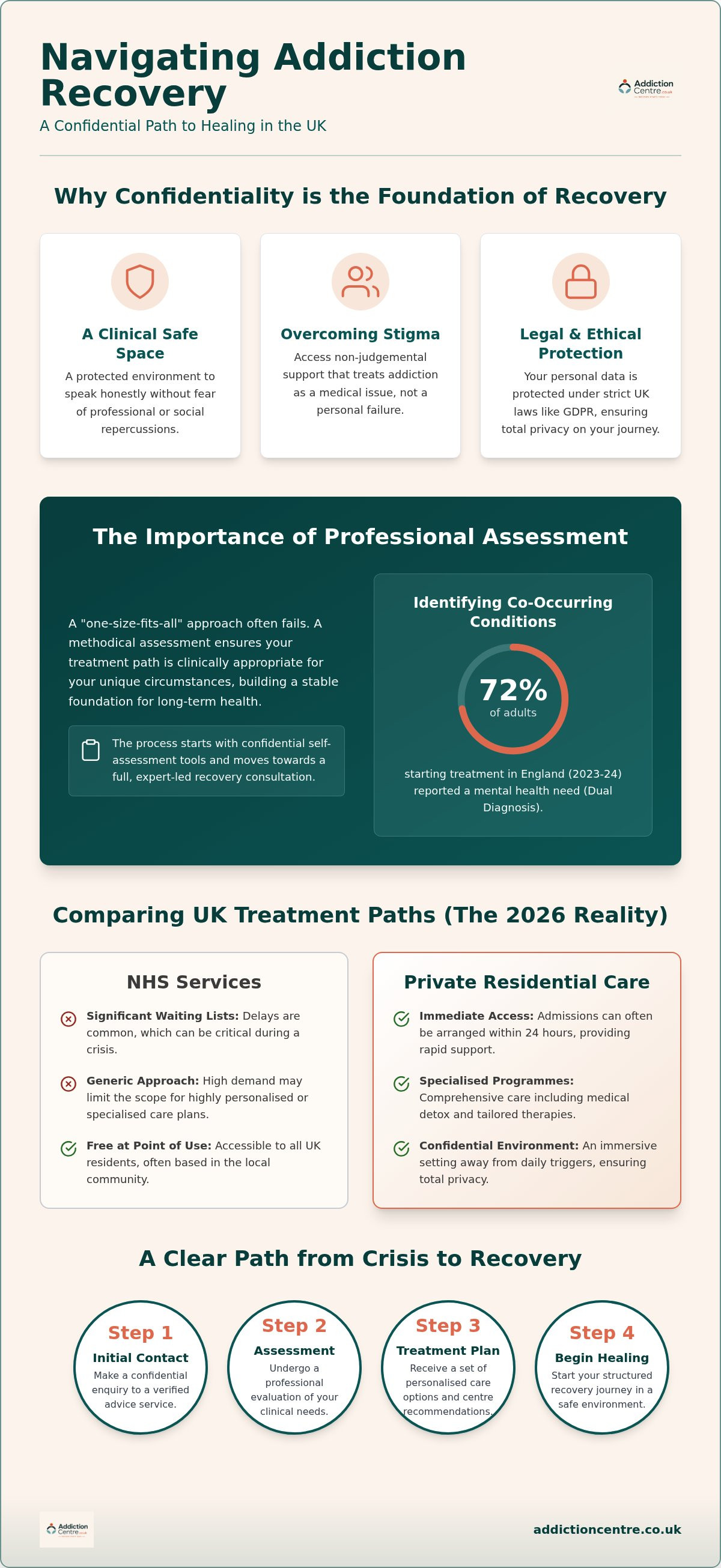
Recovery begins with a sense of safety. When you first reach out, your primary concern is often whether your private struggle will remain just that: private. Seeking confidential addiction advice UK services isn't merely about keeping secrets. It's about establishing a clinical "safe space" where you can speak honestly about your experiences without the weight of external judgement or the fear of professional repercussions.
Confidential addiction advice is a protected space for clinical assessment without fear of stigma.
When understanding addiction as a complex and chronic health condition, it becomes clear that the initial conversation must be free from the threat of public or professional exposure. A casual conversation with a friend, whilst well-meaning, lacks the rigorous ethical framework provided by a professional service. Clinical confidentiality in the UK is a binding commitment. It ensures your personal details and treatment history are handled with the highest level of security. This professional barrier allows you to focus entirely on health and restoration rather than managing the perceptions of others.
Overcoming the Stigma of Seeking Support
The barrier of shame is one of the most significant hurdles in the recovery journey. Many individuals delay seeking help because they fear being labelled or misunderstood by their peers and employers. Professional advisors address this by providing a non-judgemental first point of contact where empathy is the standard. They aren't there to moralise; they're there to facilitate a clinical solution. By maintaining your anonymity from the very first interaction, these services remove the "shame" barrier. This allows you to explore treatment options with a sense of quiet confidence, knowing your dignity is being prioritised by experts who see addiction as a treatable medical issue rather than a personal failure.
Legal and Ethical Standards of UK Advice Services
In the UK, the protection of your personal information is governed by strict legal frameworks, including the General Data Protection Regulation (GDPR). Addiction specialists have a profound ethical duty of care to ensure that your data is stored securely and shared only with your explicit consent. This means that when you seek confidential addiction advice UK, your information is encrypted and treated with clinical rigour. There are, however, specific legal limits to this privacy. If there is an immediate and serious risk to your life or the lives of others, specialists are required to intervene to ensure safety. Outside of these rare crisis scenarios, your journey remains your own, protected by both law and professional integrity.
The Role of Professional Assessments in Finding the Right Support
Recovery is rarely a linear process. Because every individual's history with substance use is unique, a "one size fits all" approach to treatment almost always fails to address the underlying causes of dependency. Effective confidential addiction advice UK services prioritise a methodical assessment process to ensure that the path you choose is clinically appropriate for your specific circumstances. This precision doesn't just improve the chances of initial sobriety; it builds a more stable foundation for long-term health.
Initial clarity often begins with a confidential online self-assessment. These tools allow you to reflect on your behaviours and the impact of substance use on your life within a low-pressure, private environment. This data then serves as a vital starting point when you transition to an expert recovery consultation. A professional assessment is also the primary way to identify co-occurring mental health conditions, frequently referred to as a Dual Diagnosis. With data from 2023-2024 showing that 72% of adults starting treatment in England reported a mental health need, identifying these integrated requirements early is essential for a successful outcome.
Determining the Level of Care Required
One of the most critical decisions involves choosing between residential rehab and outpatient treatment. Whilst outpatient care allows for more flexibility, residential settings provide a structured, immersive environment that removes you from the triggers of daily life. For those facing a high degree of physical dependency, a residential drug detox UK programme is often the necessary first step. This ensures that the withdrawal process is managed by medical professionals who can provide 24-hour support and pharmacological intervention if required to maintain your safety and comfort.
Expert Recovery Consultations Explained
A professional consultation call acts as a bridge between your current state of uncertainty and a structured clinical environment. During this dialogue, a consultant will listen to your history, your professional requirements, and your personal preferences to match you with a provider that fits your specific profile. Whilst you can find NHS confidential support and resources online, a private consultation offers a more tailored and immediate route to specific clinics. These personalised recommendations are far more effective than generic lists because they account for your clinical needs and your desire for privacy. If you are feeling overwhelmed by the options available, you can access a professional recovery consultation to begin your journey with a clear, expert-led plan.
Comparing Private Treatment and NHS Services in the UK
Deciding between public and private care is a pivotal moment in the recovery journey. Whilst the NHS provides essential community-based support, the reality in 2026 is one of unprecedented demand. Data from 2024-2025 shows that 329,646 adults were in contact with drug and alcohol treatment services in England, the highest number since reporting began. This volume often results in significant waiting lists for residential placements, making confidential addiction advice UK essential for those who need to understand their alternatives and move toward treatment without delay.
The intensity of care also differs between the two sectors. NHS services are primarily community-focused, which means treatment occurs whilst you remain at home, attending scheduled appointments. In contrast, private residential rehab offers 24/7 clinical monitoring in a controlled environment. This level of immersion is often necessary for those with a high risk of relapse or those who require a medically supervised detox to manage physical withdrawal symptoms safely. By choosing a private referral, you're opting for a level of clinical depth that prioritises immediate safety and long-term stabilisation.
Accessing Care Without a Waiting List
Speed is often the most critical factor in a successful intervention. When an individual reaches the point of being "ready" for change, that window of opportunity is fragile. Private residential rehabs typically offer an admission window of 24 to 48 hours, bypassing the traditional GP gatekeeping and local authority assessment panels that can take weeks or months. This rapid response ensures that the momentum for recovery isn't lost to administrative delays. Referral services facilitate this by connecting you directly to clinics that have immediate availability, providing a streamlined path that public services simply cannot match during periods of high demand.
The Cost-Benefit Analysis of Private Rehab
Whilst public services are free, the long-term "cost" of delayed treatment can be measured in deteriorating health, strained family dynamics, and professional instability. You can find various vetted addiction support organizations through mental health charities, but for those requiring immediate and intensive intervention, the private sector remains the most responsive option. When evaluating confidential addiction advice UK, it's important to consider that private fees generally cover a comprehensive suite of services, including bespoke therapy and aftercare. If you are concerned about the financial commitment, reviewing a guide on paying for rehab in the UK can help you evaluate funding and insurance options for 2026.
How to Navigate the UK Addiction Treatment Directory
Finding the right clinic shouldn't feel like a shot in the dark. Whilst many people begin their search with local services, a national scope is often required to find the specific clinical expertise your situation demands. Using a comprehensive UK addiction treatment directory allows you to look beyond your immediate postcode to find facilities that specialise in your specific substance or behaviour, whether that's alcohol, drugs, or gambling. This broader search is particularly valuable when you require the specialised confidential addiction advice UK practitioners offer, as it ensures your choice is based on clinical merit rather than just geographical convenience.
Accessing confidential addiction advice UK services through a national directory ensures you aren't limited by the availability of local NHS resources. When browsing the directory, the most important metric to verify is the Care Quality Commission (CQC) registration. The CQC is the independent regulator of health and social care in England; their ratings provide an objective measure of whether a facility is safe, effective, and well-led. By prioritising clinics with high CQC ratings, you can move forward with the confidence that your chosen centre meets the rigorous standards required for clinical excellence in 2026.
Evaluating Treatment Facility Referrals
Reading a clinic profile effectively requires looking past the amenities to the therapeutic core. You should identify whether a centre offers evidence-based therapies like Cognitive Behavioural Therapy (CBT) or Dialectical Behaviour Therapy (DBT), or if they follow a traditional 12-Step model. Equally important is the presence of a robust aftercare programme. Recovery doesn't end when you leave a residential facility; it's the ongoing support and relapse prevention strategies that sustain your progress in the months and years to follow. A quality referral will always highlight the long-term support structure available to you.
Family Support and Interventions
If you're searching on behalf of a loved one, the directory serves as a vital tool for family empowerment. It provides a structured way to compare options and seek advice on organising a professional intervention. Many families feel a sense of desperation when a relative refuses help, but there are clear, legal, and compassionate ways to navigate this. You can find detailed guidance on how to get someone into rehab UK to help you understand the boundaries of support and the steps required to initiate a life-saving change. If you're ready to explore these options, you can search our national treatment directory to find a facility that aligns with your family's needs.
Taking the First Step with Addiction Centre
The transition from a state of crisis to a structured recovery plan is often the most daunting part of the journey. You've researched the options, compared the services, and weighed the costs. Now, the focus shifts to action. Addiction Centre serves as your impartial, confidential guide through this final stage of decision-making. We don't provide the medical treatment ourselves; instead, we act as the expert bridge that connects you with the UK's premier residential facilities. This impartiality ensures that our recommendations are based solely on your clinical needs and personal recovery goals.
Before you make your first enquiry for confidential addiction advice UK, it's helpful to gather a few details. Think about your history with the substance, any previous attempts at recovery, and whether you're currently experiencing mental health challenges like anxiety or depression. Having this information ready allows our advisors to provide a more precise match during your consultation. Remember, this isn't about being perfect; it's about being honest in a safe, protected environment. Recovery is a reality for thousands of people across the country every year. With the right clinical framework, it can be your reality too.
Our Commitment to Your Privacy
Your dignity is our priority. We operate with a strictly non-judgmental, clinical approach that treats addiction as the health issue it is. When you reach out, you can rest assured that your data and the details of your enquiry are handled with absolute discretion. We adhere to the highest standards of data protection, ensuring your professional reputation and personal life remain undisturbed whilst you seek the help you deserve. This professional boundary provides the peace of mind necessary to focus entirely on your restoration, away from the noise and stigma of the outside world.
Ready to Start Your Recovery Journey?
The path to health is built on small, manageable steps. Your first move can be as simple as completing our confidential online assessment tool. This provides an initial layer of clarity and helps you articulate your needs. From there, you can contact an advisor for a personalised recovery consultation. This dialogue is your opportunity to ask specific questions about clinic locations, detox protocols, and aftercare support. You don't have to navigate this complexity alone. By taking this first step, you're moving away from the confusion of the past and toward a future defined by health and agency. If you're ready to explore your options, you can book a confidential recovery consultation today to begin your journey with expert guidance.
Your Path to Restoration Starts Here
Finding the right support in 2026 requires balancing clinical precision with a deep respect for your personal privacy. We've explored how professional assessments act as a vital roadmap, ensuring that your treatment plan is tailored to your specific history rather than a generic model. Whilst public services provide a foundation, the immediate availability and 24/7 monitoring found in private residential care often provide the stable environment necessary for those in high-stress situations. By utilising our national directory of CQC-regulated clinics, you can move beyond local limitations to find the expert care that truly fits your profile.
Addiction Centre acts as your steady guide, providing confidential addiction advice UK residents can rely on with absolute certainty. Our expert clinical advisors offer a 100% confidential and non-judgemental service that prioritises your dignity above all else. You don't have to carry the weight of this transition alone. Start your confidential recovery consultation today and move toward a future defined by health and agency. Restoration is entirely possible, and the first step is simply reaching out for the professional support you deserve.
Frequently Asked Questions
Is addiction advice in the UK truly confidential?
Yes, seeking confidential addiction advice UK services is protected by both clinical ethics and data protection laws such as GDPR. Your personal details and the nature of your struggle are held in strict confidence by professional advisors. This privacy is only set aside in rare, specific circumstances where there is an immediate risk of serious harm to yourself or others, which is a standard safety protocol across all UK healthcare sectors.
Can I get advice for a family member without them knowing?
You can certainly seek professional guidance and explore potential treatment options on behalf of a loved one. Expert advisors help you understand the different levels of care available and provide strategies for initiating a compassionate conversation about recovery. Whilst the individual must ultimately agree to participate in clinical treatment, your initial enquiry and the information you share remain entirely private.
Do I need a referral from my GP to access private rehab?
You don't need a GP referral to access private residential treatment. Unlike the NHS route, which usually requires a structured assessment through local authority panels and community teams, private clinics allow for direct admission. This bypasses the traditional gatekeeping process, which is often a significant advantage for those who require immediate stabilisation and wish to maintain a higher level of personal discretion.
How much does a professional addiction consultation cost?
The cost of a consultation can vary depending on the depth of the clinical assessment required for your specific situation. Because every individual's needs are unique, it's best to contact an advisor directly to discuss your circumstances. They can explain how the matching process works and outline the steps involved in finding a placement in a CQC-regulated facility that meets your medical and personal requirements.
What is the difference between a referral service and a treatment centre?
A referral service acts as an impartial guide to help you navigate the complex landscape of recovery options. We don't provide medical treatment or on-site detox ourselves. Instead, we use our directory and clinical expertise to match you with a treatment centre that provides the actual medical care, such as residential detox or therapy, ensuring the facility aligns with your specific diagnosis.
How quickly can I be admitted to a detox programme through your directory?
Admission to a private detox programme can often be organised within 24 to 48 hours. Once your initial assessment is complete and a suitable facility is identified, the transition into a clinical environment happens very quickly. This rapid response is vital for those who are physically dependent and need immediate medical supervision to manage withdrawal symptoms safely and comfortably.
Is gambling addiction covered by confidential advice services?
Yes, gambling addiction is a recognised condition that is fully supported by our confidential addiction advice UK services. Many individuals who struggle with substance use also face challenges with behavioural addictions. We ensure that the clinics we recommend have the specific expertise required to treat these co-occurring issues, providing a holistic approach to your long-term recovery and well-being.
Will my employer find out if I seek addiction advice?
Your employer won't be notified if you seek advice or enter treatment unless you choose to disclose that information yourself. Confidentiality is a fundamental cornerstone of professional addiction services. Whilst some individuals choose to share their situation to access sick pay or occupational health support, the decision to share your medical history remains entirely in your hands, protecting your professional reputation.


