
What if the true price of recovery isn't just a figure on a balance sheet, but a measure of the safety and clinical expertise you receive in return? You've likely spent hours searching for a clear answer on rehab cost UK, only to find a confusing array of price tiers and hidden fees that leave you feeling more anxious than when you started. It's perfectly natural to feel overwhelmed when you're trying to make a life-changing decision whilst navigating a landscape of varying standards and the pressure of rising drug-related fatalities, which increased by 11% in recent years.
We promise to strip away the ambiguity by providing a transparent breakdown of how private facilities structure their fees in 2026. You'll learn how the recent implementation of the Mental Health Act 2025 affects patient safeguards and why clinical intensity often dictates the final investment. We will explore the differences between residential programmes and outpatient support; explain how to verify current CQC standards; and help you identify the funding routes that make high-quality treatment accessible. This guide provides a clear framework to compare clinics with confidence, ensuring your path to restoration is built on a foundation of value and integrity.
Key Takeaways
- View private treatment as a clinical investment in your future health, weighing the initial expense against the significant long-term financial and personal toll of active addiction.
- Understand how specific medical requirements, such as supervised detox and high staff-to-patient ratios, directly influence the 2026 rehab cost UK.
- Compare the immediate accessibility of private residential care with current NHS waiting times to ensure you act whilst the window of opportunity for recovery is open.
- Explore diverse funding routes, including private health insurance and employer-sponsored programmes, to find high-quality care that aligns with your financial situation.
- Utilise an impartial treatment directory and recovery consultations to accurately match your clinical needs with a safe, CQC-regulated facility.
Understanding the Financial Commitment of Private Addiction Treatment
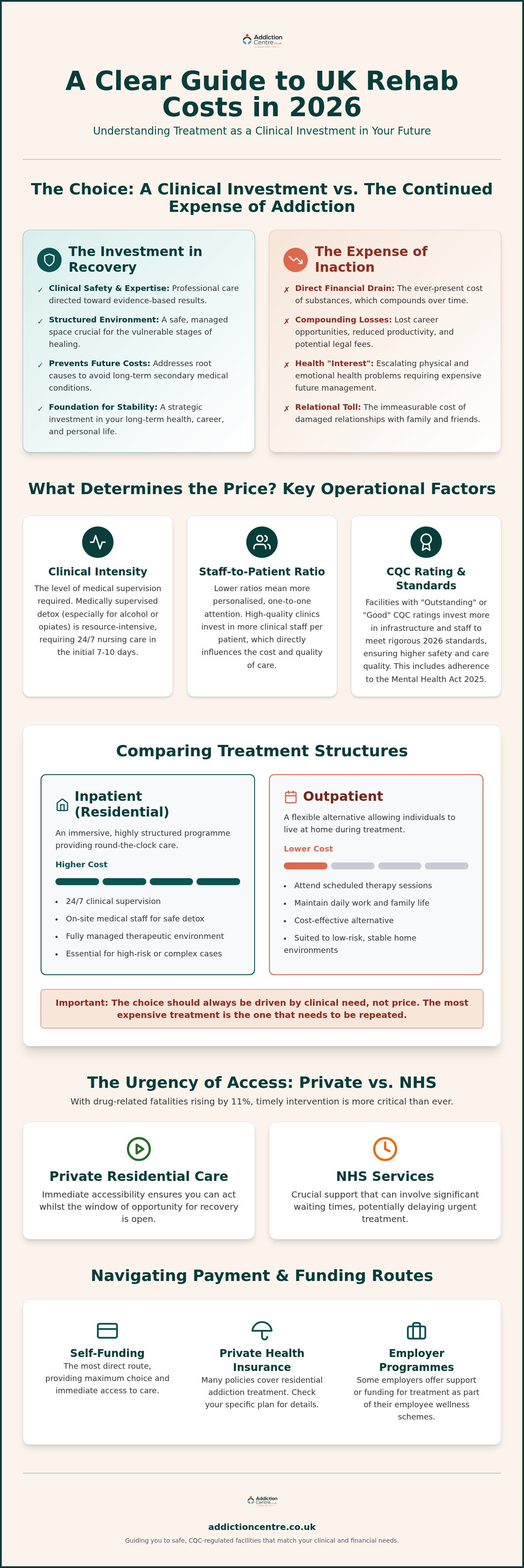
When you begin researching the rehab cost UK, it's helpful to view the expenditure not as a simple fee, but as a strategic clinical investment in your future health. For many families, the initial price tag feels daunting; yet, it often pales in comparison to the cumulative financial drain of active addiction. 2026 has seen a significant shift in the sector toward value-based pricing, where clinics are more transparent about their outcomes and operational costs. Professional care is no longer a luxury reserved for a high-net-worth demographic; it's a vital medical necessity for anyone seeking restoration and long-term stability.
The "Cost of Inaction" is a concept frequently overlooked during the initial search for help. Active addiction carries a heavy financial burden that compounds over time. This includes the direct cost of substances, lost career opportunities, and escalating legal fees. There's also the "interest" paid in physical and emotional health, as chronic substance use often leads to secondary medical conditions that require expensive, long-term management. A structured environment provided by drug rehabilitation programs ensures that every pound spent is directed toward clinical evidence and safety, rather than the chaotic and destructive expenses of a crisis.
The Investment in Health vs the Expense of Addiction
Addiction is an expensive condition to maintain. When you calculate the daily spend on substances alongside the hidden costs of reduced productivity and damaged relationships, the price of a 28-day programme often represents a significant saving over the course of a single year. Delaying professional intervention only increases the clinical complexity of the case, which can lead to higher costs later. Rehab is a clinical intervention that prevents long-term healthcare costs. By addressing the root causes of dependency now, you're effectively insulating yourself from the financial volatility that addiction creates in a person's life.
Inpatient vs Outpatient Financial Structures
Understanding why price points vary so widely requires a look at the intensity of care provided. Residential or inpatient care carries a higher price tag because it includes 24/7 clinical supervision, on-site medical staff, and a fully managed therapeutic environment. This level of intensity is often necessary for those requiring a safe detox or those with a high risk of relapse. Conversely, outpatient treatment can be a more cost-effective alternative for individuals with a stable, supportive home environment and a lower clinical risk profile. Whilst the rehab cost UK for outpatient services is lower, the choice should always be driven by clinical need rather than price alone, as the most expensive treatment is the one that needs to be repeated due to an insufficient level of initial care.
Clinical and Operational Factors Defining the Cost of UK Rehab
When comparing different facilities, it becomes clear that the rehab cost UK is largely determined by the depth of clinical expertise and the safety protocols in place. A facility's Care Quality Commission (CQC) rating serves as a vital indicator of these standards; clinics with "Outstanding" or "Good" ratings typically invest more in their workforce and infrastructure to meet rigorous 2026 regulations. This investment translates into higher staff-to-patient ratios, ensuring that you or your loved one receives the constant, personalised attention required during the most vulnerable stages of recovery. Whilst a lower-cost facility might offer basic support, a high-quality clinical environment provides the specialised medical oversight that significantly reduces the risk of complications.
Medical Detoxification and Clinical Supervision Intensity
The first 7 to 10 days of any programme are often the most resource-intensive. Medical detoxification requires 24-hour nursing care to manage withdrawal symptoms safely and provide necessary pharmacological support. The type of substance involved dictates the level of medical intervention; for instance, alcohol and opiate withdrawals carry distinct physical risks that demand constant monitoring. Opting for a residential drug detox UK ensures that you are in a controlled environment where medical professionals can react instantly to any changes in your condition. This level of clinical supervision is a primary driver of initial costs, but it remains the safest alternative to home-based attempts, which often lack the necessary emergency protocols.
Facility Standards and Therapeutic Specialisations
Beyond the initial detox, the operational expenses of a clinic are influenced by the variety and quality of therapies offered. A standard clinical setting might focus on group sessions, whilst more comprehensive facilities integrate evidence-based practices such as Cognitive Behavioural Therapy (CBT), EMDR for trauma, or equine-assisted therapy. There is also a significant cost associated with dual diagnosis treatment UK, which requires a multidisciplinary team capable of treating addiction alongside co-occurring mental health conditions. Government data on the return on investment for treatment suggests that these intensive, specialised programmes provide the best long-term value by addressing the root causes of substance use, thereby lowering the likelihood of future relapse. Many reputable providers now include robust aftercare programmes within their primary fee, recognising that the transition back to daily life is a critical phase of the journey. If you're unsure which level of care fits your specific situation, a recovery consultation can help clarify the clinical requirements and associated costs for your unique needs.
Private Rehab vs NHS Services: Comparing Accessibility and Outcomes
Choosing between private treatment and the NHS is one of the most significant decisions you'll face. Whilst the NHS offers "free" care at the point of use, the reality of community-based treatment often involves a fragmented approach that can be difficult to manage during a crisis. In contrast, private residential care provides an all-inclusive clinical environment where every aspect of your recovery is managed under one roof. When you evaluate the rehab cost UK, you're often paying for the removal of administrative hurdles that can otherwise delay life-saving treatment. The Care Quality Commission (CQC) oversees both sectors, ensuring that regardless of the funding route, facilities must meet fundamental safety and care standards.
Waiting Times and the Impact on Recovery Success
Time is a critical factor in addiction recovery. In 2026, although government data shows that many individuals start community-based treatment within three weeks, this figure rarely applies to residential placements. Getting a referral for a bed in a dedicated facility through a local authority can take months of assessment and "proof" of engagement. For those in a state of active addiction, this delay carries immense clinical risk. The primary advantage of the private sector is the ability to secure an immediate admission. Accessing a rehab without waiting list UK ensures that you can capitalise on the moment you or your loved one decides to seek help, rather than watching that resolve fade whilst waiting for a phone call. This immediate intervention often makes the difference between a successful entry into recovery and a continued cycle of substance use.
Funding Routes: Local Authority vs Self-Funding
Securing local authority funding requires navigating a complex system of criteria. You'll often be required to complete a period of community-based "pre-rehab" to prove your commitment before a residential placement is even considered. Whilst this works for some, many families find these hurdles insurmountable during a period of high stress. Self-funding or using private insurance allows you to bypass these assessments entirely. It also grants you the freedom to choose the specific therapeutic model that resonates with your personal values. Whether you prefer a traditional 12-step approach or a secular, evidence-based programme, private care offers a level of choice and agency that the public sector cannot provide. By self-funding the rehab cost UK, you're essentially purchasing the right to a tailored, immediate, and uninterrupted path to restoration, avoiding the limitations of community-based detox that may not offer the same level of 24-hour clinical safety.
Navigating Payment Routes and Budgeting for Long-Term Recovery
Financing your journey toward health shouldn't be a source of additional trauma. Whilst the headline rehab cost UK might initially seem high, several structured pathways exist to make this investment manageable for families and individuals. Many people don't realise that their existing workplace benefits or private insurance policies often cover a significant portion of the fees. By understanding the available financial mechanisms, you can move from a state of uncertainty toward a clear, actionable plan for admission.
Self-Funding and Private Health Insurance Pathways
The first step in financial planning is a thorough review of your private health insurance policy. Major UK insurers now recognise addiction as a treatable medical condition. Providers such as Bupa, AXA, and Vitality often include mental health provisions that extend to residential treatment, provided the facility is recognised by their network. To verify your coverage, you'll typically need your policy number and a summary of your clinical needs. Most reputable clinics employ dedicated coordinators to assist with the "pre-authorisation" process. These professionals communicate directly with your insurer to confirm which aspects of the programme are covered, reducing the administrative burden on you during a period of high stress.
Employer-sponsored health schemes and Employee Assistance Programmes (EAPs) are also valuable resources. These confidential schemes are designed to support staff through personal crises, and some larger organisations offer specific grants or top-up payments for addiction treatment. If you're self-funding, don't hesitate to ask about payment plans. Some facilities allow families to spread the rehab cost UK over several months, making high-quality clinical care accessible without requiring the full sum upfront.
Assessing All-Inclusive vs Pay-As-You-Go Models
When comparing quotes from different centres, clarity is your best defence against hidden costs. Some facilities operate on a "pay-as-you-go" basis, where medication, specialised trauma therapy, or even laundry services are billed as extras. This can lead to significant financial anxiety as the weeks progress. A fixed-price, all-inclusive model is generally more supportive, as it allows for precise budgeting from the outset. You should ensure your quote covers the entire clinical journey, including the initial assessment, meals, and 24-hour nursing support.
It's particularly important to check if a residential alcohol detox phase is bundled with the subsequent therapy programme. Separate billing for the detox and therapy phases is a common practice that can lead to unexpected financial surprises. A truly comprehensive programme will also include a robust aftercare plan, ensuring your investment continues to provide value long after you've left the facility. If you're feeling overwhelmed by the variety of pricing structures, our recovery consultations can help you identify a facility that matches both your clinical requirements and your financial boundaries.
How Addiction Centre Simplifies the Search for Affordable Treatment
Searching for life-saving treatment whilst in the midst of a personal or family crisis is an exhausting endeavour. The sheer volume of information regarding the rehab cost UK can be paralysing, often leading to a state of "decision fatigue" that prevents action. Addiction Centre serves as a steady guide in this landscape, acting as a bridge between your current state of uncertainty and a structured, professional environment. By utilising an impartial addiction treatment directory, you gain immediate access to a curated selection of facilities that have already been vetted for clinical integrity and safety.
Our recovery consultations are designed to remove the burden of "shopping around" from your shoulders. Instead of making dozens of calls to individual clinics, you speak with a dedicated advisor who understands the nuances of the 2026 recovery sector. We listen to your specific clinical needs, such as the requirement for a dual diagnosis programme or a specific detox protocol, and match these against your budgetary boundaries. This ensures that the options we present are not only medically appropriate but also financially sustainable for the long term.
Impartial Guidance Through the Referral Process
The value of impartial guidance lies in our ability to filter through the noise. Our experts categorise clinics based on their most recent CQC ratings, therapeutic specialisations, and price tiers. This methodical approach allows us to provide a clear comparison of facilities without the bias of a single provider. Having a single point of contact for multiple clinic assessments simplifies the administrative process, allowing you to focus your energy on the emotional preparation required for recovery. We empower families by providing the right financial questions to ask during the admissions process, ensuring that the path you choose aligns perfectly with both your medical requirements and your financial reality.
Accessing Our National Network of Recognised Clinics
We prioritise partnerships with clinics that demonstrate proven outcomes and maintain transparent pricing structures. In a market where costs can vary significantly, our national network provides a safeguard against facilities that may lack the necessary clinical depth. Every referral we make is grounded in the principle of dignity, ensuring that the individual receives the highest possible standard of care for their investment. You don't have to navigate this complex journey alone. By starting with a confidential consultation, you can move forward with the quiet confidence that you are making an informed, safe, and valued choice for your future. To take the first step toward restoration, you can speak with a compassionate advisor about your treatment options today.
Taking the First Step Toward Lasting Restoration
Navigating the complexities of rehab cost UK requires a vital shift in perspective, moving from the immediate financial pressure to the long-term value of a life fully restored. You now understand that whilst clinical intensity and CQC-regulated safety standards drive the initial investment, they also provide the essential foundation for a sustainable recovery. Whether you are utilising private health insurance, employer-sponsored schemes, or self-funding routes, the priority remains finding a facility that aligns with your medical needs and personal values. Professional support is not just a service; it's a strategic intervention that protects your future health and financial stability.
Addiction Centre provides the clarity you need through our impartial national directory and confidential self-assessment tools. Our expert consultants are dedicated to matching your specific budget and clinical requirements with a safe, recognised clinic, ensuring you avoid costly mistakes during a time of crisis. You don't have to carry the weight of this search alone. Start your confidential recovery assessment today and let us help you find the high-quality care you deserve. There is a clear path from confusion to clarity, and your journey toward healing can begin right now.
Frequently Asked Questions
How much does private rehab cost on average in the UK?
Average costs for residential treatment in the UK typically range between £2,000 and £5,000 per week, depending on the facility's clinical intensity and location. For a standard 28-day programme, you might expect to invest between £6,000 and £12,000, whilst luxury facilities can exceed £10,000 per week. These figures reflect the level of medical supervision and the breadth of therapeutic services provided to ensure a safe recovery environment.
Is it possible to get addiction treatment for free on the NHS?
Yes, free addiction treatment is available through the NHS, though it primarily focuses on community-based support rather than residential stays. Whilst waiting times for initial interventions are often three weeks or less, securing a referral for a residential placement involves complex local authority assessments. Many individuals find that private care offers the immediate admission necessary to capitalise on their motivation for change.
Does BUPA or AXA health insurance cover the cost of rehab?
Most major UK health insurance providers, including BUPA and AXA, recognise addiction as a treatable medical condition and may cover the rehab cost UK. Coverage typically depends on your specific policy and whether the facility is part of the insurer's recognised network. It is essential to seek pre-authorisation through your provider; this is a process that many clinics can assist with during your initial consultation.
What is the cheapest way to access professional addiction support?
The most cost-effective professional options include outpatient programmes or online addiction therapy, which typically range from £300 to £1,000 per week. These routes allow you to receive expert clinical guidance whilst remaining at home. Whilst these are more affordable than residential care, they are best suited for individuals with a stable living environment and a lower risk of severe withdrawal complications.
Are there hidden costs in private rehab that I should be aware of?
Some facilities may charge additional fees for specific medical requirements, such as certain detox medications, or for supplemental services like laundry and family therapy sessions. To avoid financial surprises, you should always ask for a fixed-price, all-inclusive quote before admission. This ensures that your clinical journey, from initial assessment to final discharge, is fully accounted for within your budget from the outset.
Can I pay for rehab in monthly instalments?
Many private clinics in the UK now offer financing options or internal payment plans to help families spread the cost of treatment over a longer period. These arrangements allow you to access immediate life-saving care without requiring the total sum upfront. During your recovery consultation, you can discuss your financial boundaries to identify facilities that provide flexible payment structures tailored to your situation.
What happens if I cannot afford the full length of a residential programme?
If a full 28-day residential stay is beyond your current budget, you may consider a shorter, intensive 7 to 10-day medical detox followed by structured outpatient support. This approach prioritises clinical safety during the most dangerous phase of withdrawal whilst reducing the overall financial commitment. It is vital to work with a consultant to ensure your step-down plan remains clinically sound and supportive of long-term sobriety.
Is aftercare usually included in the initial cost of treatment?
Reputable rehab centres often include a period of aftercare, such as weekly group sessions for six to twelve months, within their primary programme fee to support your long-term rehab cost UK investment. This ongoing support is a critical component of the recovery process, helping to prevent relapse during the transition back to daily life. Always verify the duration and format of the aftercare provided to ensure you are receiving the best value for your journey.


