
What if the most effective way to break the cycle of addiction isn't through sheer willpower alone, but by systematically rewiring the way your brain processes every daily challenge? It’s common to feel completely trapped in negative thought cycles, and when you're seeking cognitive behavioural therapy for addiction UK, the frustration of facing an NHS waiting list of up to nine months for residential rehab can make recovery feel out of reach. You aren't alone in feeling overwhelmed by the different types of support available or the complexity of the healthcare system.
This 2026 guide demonstrates how CBT provides a practical, clinical framework for lasting change. We’ll show you how these sessions address the root causes of substance use and why 50% of referrals to talking therapies successfully move into recovery. By the end of this article, you'll have a clear understanding of the therapeutic process and a direct pathway to recognised UK treatment centres. We're here to help you move from a state of confusion toward a structured, professional environment where healing is possible.
Key Takeaways
- Understand how CBT acts as a gold standard treatment by addressing the clinical links between your thoughts, feelings, and addictive behaviours.
- Learn the science of functional analysis and skills training to identify your personal triggers and develop healthier coping mechanisms for long-term recovery.
- Navigate the practical differences between NHS and private pathways for cognitive behavioural therapy for addiction UK, including how to manage current waiting times.
- Discover what to expect from a professional therapeutic environment, focusing on goals such as improved social functioning and sustainable abstinence.
- Gain a clear pathway to recognised treatment providers through impartial advice and personalised recovery consultations tailored to your specific needs.
What is Cognitive Behavioural Therapy (CBT) for Addiction?
Cognitive Behavioural Therapy (CBT) is a highly structured, evidence-based talking therapy that examines the complex relationship between your thoughts, feelings, and behaviours. Unlike some forms of therapy that may feel open-ended or purely reflective, cognitive behavioural therapy for addiction UK is intentionally goal-oriented and time-limited. It operates on the principle that whilst we can't always control our external circumstances, we can change how we interpret and respond to them. This makes it an exceptionally powerful tool for those struggling with substance misuse.
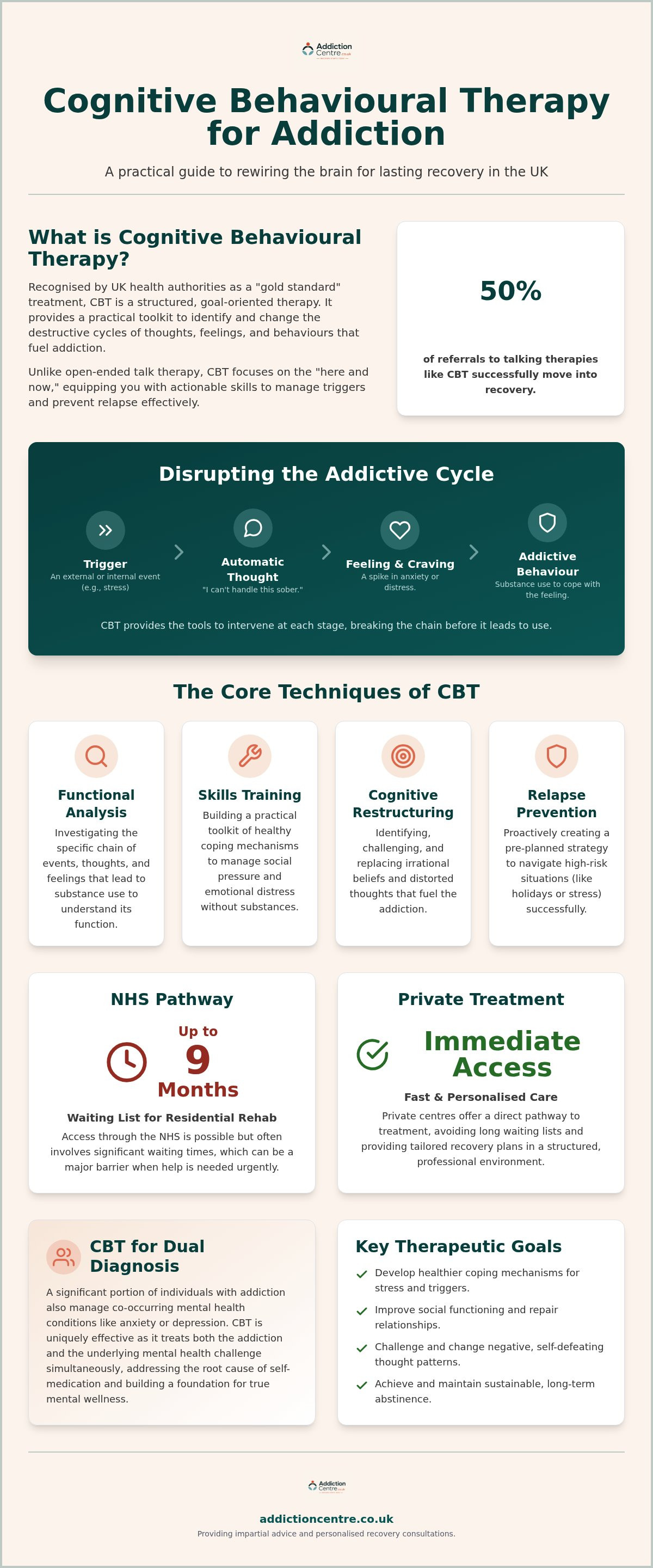
UK health authorities, including the National Institute for Health and Care Excellence (NICE), recognise CBT as a "gold standard" treatment for addiction. It differs from traditional counselling because it doesn't just provide a space to talk; it provides a toolkit for action. You'll work to identify the "addictive cycle," a loop where a negative thought triggers a distressing emotion, leading to a craving and, ultimately, the behaviour of using. For example, a stressful interaction might trigger the thought "I can't handle this sober," which creates a spike in anxiety. CBT gives you the practical interventions needed to interrupt this cycle before the craving turns into action.
The Core Principles of CBT in a Clinical Setting
The primary focus of CBT is the "here and now." While your past experiences are valid and often shaped your current situation, the therapy prioritises the challenges you face today and the triggers you'll encounter tomorrow. It's a collaborative process where you and your therapist act as a team to solve problems. Cognitive restructuring is the process of identifying and challenging irrational beliefs that fuel your addiction. By replacing these distorted thoughts with more balanced, realistic perspectives, you can significantly lower the emotional intensity that often leads to a relapse.
CBT and Dual Diagnosis Treatment in the UK
When you access cognitive behavioural therapy for addiction UK, you're often addressing more than just substance use. It's incredibly common for addiction to exist amongst other mental health challenges. Statistics from early 2026 indicate that a significant portion of those seeking help for substance use also manage conditions like clinical anxiety or depression. This is known as dual diagnosis. CBT is uniquely suited for this because it treats both the addiction and the underlying mental health condition simultaneously.
By addressing the underlying depression or anxiety, the urge to self-medicate with substances often diminishes. For a deeper look at how these services are integrated, you can read our guide on Dual Diagnosis Treatment UK: A Guide to Integrated Recovery in 2026. This holistic approach ensures that you aren't just stopping a habit, but building a foundation for genuine mental wellness and long-term stability.
The Science of Rewiring: How CBT Disrupts the Addictive Cycle
CBT isn't a passive experience where you simply recount your week. It's a clinical process of "rewiring" the brain's response to stress and cravings. Central to cognitive behavioural therapy for addiction UK is Functional Analysis. This is an investigative phase where you and your therapist map out the specific chain of events that lead to substance use. By understanding the function your addiction serves, you can begin to replace it with healthier alternatives through Skills Training. This isn't just talk; it's about building a practical toolkit to handle social pressure and emotional distress without relying on a substance.
Relapse prevention is the final piece of this skill-building puzzle. By preparing for high-risk situations, such as a festive holiday or a particularly stressful work week, you reduce the power those events hold over you. You're no longer reacting blindly. Instead, you're responding with a pre-planned strategy. This proactive approach transforms the recovery journey from a struggle of willpower into a manageable series of learned responses.
Identifying High-Risk Triggers and Automatic Thoughts
Triggers generally fall into two categories: external and internal. External triggers are the people, places, or objects associated with use, whilst internal triggers are the emotions or physical sensations that precede a craving. These triggers often spark "automatic thoughts," which are split-second interpretations of a situation that feel like facts. In addiction, these are often distorted. You might experience "all-or-nothing" thinking, where a small setback feels like a total catastrophe. Recognising these distortions is the first step in disrupting the cycle before a craving takes hold. If you're looking into accessing CBT on the NHS, you'll find that identifying these patterns is a core part of the initial sessions.
Behavioural Experiments and Real-World Application
The true power of CBT lies in its application outside the therapist's office. Behavioural experiments allow you to test your beliefs in a safe, controlled way. If you believe you can't socialise without a drink, your therapist might suggest attending a brief gathering whilst remaining sober to observe what actually happens. These "homework" assignments are vital. They bridge the gap between clinical theory and daily life. Active participation is non-negotiable for long-term recovery success. It’s about proving to yourself that you possess the agency to choose a different path. If you feel ready to begin this process, a recovery consultation can help you find a programme that specialises in these evidence-based techniques.
Accessing CBT in the UK: NHS vs Private Treatment Options
Choosing the right path for cognitive behavioural therapy for addiction UK depends on your clinical needs and the urgency of your situation. Whilst the UK offers both public and private routes, the experience and speed of delivery differ significantly. Understanding these nuances is essential for anyone in a state of crisis or planning a long-term recovery strategy. Both systems aim for recovery, but the timeline and intensity of support vary.
The NHS Pathway and Potential Barriers
The standard route begins with a GP appointment. Most doctors follow a "stepped care" model, starting with low-intensity interventions before moving to more specialised care. You can also self-refer to NHS Talking Therapies. According to January 2026 data, 88.7% of referrals for these services wait less than six weeks. However, these programmes often focus on general anxiety or depression. For severe substance use, you may require intensive, addiction-specific CBT that general mental health services aren't always equipped to provide. You can find more details in this NHS overview of Cognitive Behavioural Therapy.
The biggest challenge remains the "postcode lottery" for specialist residential care. In England, waiting times for NHS-funded inpatient detox or rehab can range from three to nine months in 2026. For someone in active addiction, this delay can be dangerous. Local authority funding is often stretched, meaning only the most severe cases receive immediate inpatient support. This creates a gap where many individuals feel left behind by the public system.
The Private Sector: Immediate Access and Specialist Care
Private clinics offer a faster alternative, with admissions often possible within one to three weeks. In these settings, cognitive behavioural therapy for addiction UK is integrated into a 24/7 therapeutic environment. You aren't just attending a weekly session; you're immersed in a culture of recovery. This multidisciplinary approach includes doctors, nurses, and specialist therapists working together to support your progress. It ensures that clinical interventions are consistent and immediate.
Whilst private care involves costs, many find the immediate intervention life-saving. You can review the 2026 Financial Guide for UK Rehab to understand the investment involved. If you're unsure where to start, Navigating the UK Addiction Treatment Directory provides a step-by-step guide to finding a recognised provider that matches your clinical assessment. This impartial overview helps you weigh your options without the pressure of a single clinic's sales team.
The CBT Experience: Core Techniques and Therapeutic Goals
Imagine sitting in a quiet, professional room within a UK residential centre. Your session begins with a collaborative review of the previous day's challenges and a check-in on your current mood. This partnership, known as the therapeutic alliance, is the foundation of your recovery. It’s a safe space where you aren't judged for your past, but empowered to change your future. Unlike a casual conversation, cognitive behavioural therapy for addiction UK is structured and purposeful, focusing on three primary clinical outcomes: significant symptom reduction, improved social functioning, and sustainable long-term abstinence.
One of the most effective tools used in these sessions is a form of exposure therapy. In a controlled clinical environment, your therapist may help you "sit with" a craving rather than trying to suppress it. You'll learn that cravings are like waves; they peak and eventually subside. By experiencing this process without resorting to substance use, your brain begins to habituate to the discomfort. This builds the confidence that you can handle distress without a chemical crutch. If you're ready to experience this level of clinical support, you can find a specialist rehab centre through our comprehensive directory.
Cognitive Restructuring: Changing the Narrative
During your sessions, you'll learn to dissect specific events to see the thought-feeling-action chain in real time. UK therapists often use "Socratic Questioning" to help you reach your own realisations. Instead of telling you your thoughts are wrong, they'll ask questions like, "What evidence do you have for that belief?" or "Is there another way to look at this situation?" This guided discovery helps you dismantle the irrational beliefs that fuel addiction. Thought records are a practical tool for monitoring daily emotional responses and the specific triggers that precede them. By consistently documenting these patterns, you gain the clarity needed to choose a different response.
Relapse Prevention and Aftercare Planning
CBT techniques are designed to be portable, allowing you to carry your progress from the clinic back into your daily life. A mandatory part of the process is the creation of a formal Relapse Prevention Plan. This document acts as a personal manual for your sobriety, outlining your early warning signs and the specific coping strategies you'll use during high-risk moments. Recovery is an ongoing journey that requires the continued application of these principles long after you leave residential care. This structured approach ensures that you don't just leave treatment with a sense of hope, but with a concrete strategy for maintaining your health in the real world.
Choosing the Right CBT Provider: Referral and Assessment
Finding the right environment for cognitive behavioural therapy for addiction UK can feel daunting when you're already in a state of high stress. The UK treatment landscape is vast, and not every facility offers the same level of clinical expertise. At Addiction Centre, we act as a bridge between your current situation and a structured, professional environment. Our comprehensive addiction treatment directory is designed to help you identify recognised providers that align with your specific clinical needs. We prioritise clinics that hold high ratings from the Care Quality Commission (CQC), ensuring that the care you receive is safe, effective, and held to the highest national standards.
Taking the first step doesn't have to be an overwhelming leap. We encourage you to begin with a confidential online self-assessment. This simple tool provides an initial reflection on your circumstances, allowing our advisors to better understand the level of care required. It’s a gentle way to move from uncertainty toward a concrete plan for restoration and health.
The Role of an Impartial Referral Service
Navigating the complexities of the UK rehab market on your own often leads to frustration. An impartial referral service provides the clarity needed to make an informed decision without the pressure of a single clinic's sales objectives. We focus on providing personalised recommendations based on your unique profile, including any co-occurring mental health challenges. By using expert guidance and direct clinic connections, it's often possible to bypass the long waiting lists that characterise public health services, ensuring you get the help you need whilst your motivation for change is at its highest.
Preparing for Your Recovery Consultation
A professional recovery consultation is your opportunity to ensure a provider meets your expectations. When you speak with a potential clinic, it’s helpful to ask specific questions about their delivery of cognitive behavioural therapy for addiction UK. Consider asking the following:
- Are your therapists accredited by a recognised body, such as the British Association for Behavioural and Cognitive Psychotherapies (BABCP)?
- How many individual CBT sessions are included in the weekly programme?
- How is the therapy adapted for my specific type of addiction or dual diagnosis?
- What kind of aftercare support is available to help me apply these skills at home?
Seeking help isn't a sign of failure; it’s a profound act of strength and the first step toward a restored life. You don't have to walk this path alone. If you're ready to explore your options, we invite you to book a recovery consultation with one of our trained advisors today. We're here to guide you toward the safe, professional care you deserve.
Taking the First Step Toward Lasting Change
Choosing to pursue cognitive behavioural therapy for addiction UK is a decisive move toward reclaiming your agency and health. Throughout this guide, we've explored how this clinical framework provides the tools to disrupt addictive cycles by identifying high-risk triggers and restructuring irrational beliefs. By understanding the practical differences between NHS pathways and the immediate access provided by private specialist care, you can make an informed decision that suits your current needs. Whether you're managing a dual diagnosis or seeking sustainable abstinence, the evidence shows that recovery is achievable through structured, professional intervention.
You don't have to navigate these complex choices alone. Our team provides confidential expert guidance to help you find the right path amongst a network of CQC-recognised clinics. We focus on delivering personalised detox and therapy recommendations that respect your dignity and specific circumstances. Access our UK Addiction Treatment Directory and speak with a recovery expert today to begin your journey. There's a steady path forward from the storm of addiction, and we're here to walk alongside you as you take these first vital steps toward a restored life.
Frequently Asked Questions
Is CBT free on the NHS for addiction treatment?
Yes, CBT is provided free of charge through the NHS for various mental health conditions and substance misuse challenges. Access is typically managed through a GP referral or self-referral to NHS Talking Therapies. Whilst the service is free at the point of use, waiting times can be significant. In 2026, many individuals face waits of several months for intensive support, which often leads people to consider private options for more immediate clinical intervention.
How many CBT sessions will I need for addiction recovery?
The number of sessions depends on the severity of the addiction and your individual progress, but a typical course of cognitive behavioural therapy for addiction UK lasts between 6 and 20 sessions. Each session usually lasts about an hour and occurs once a week. In a residential rehab setting, these sessions may be more frequent to provide intensive support during the early stages of detox, ensuring you build a strong foundation for long-term recovery.
Can CBT help with both alcoholism and drug addiction?
Yes, CBT is an evidence-based treatment that is effective for both alcoholism and drug addiction. It focuses on the underlying cognitive patterns that drive substance use regardless of the specific substance involved. By identifying triggers and developing healthier coping mechanisms, you can learn to manage cravings for alcohol or illicit drugs. The clinical techniques, such as functional analysis, are adapted to address the unique social and physical challenges associated with each type of addiction.
What is the difference between CBT and the 12-step programme?
CBT is a clinical, evidence-based talking therapy focused on changing specific thought patterns and behaviours, whilst the 12-step programme is a peer-led, spiritual approach to recovery. CBT is delivered by a qualified professional in a structured, time-limited format. In contrast, 12-step groups like AA or NA are ongoing support communities based on shared experience. Many UK treatment centres successfully integrate both approaches to provide a comprehensive and robust recovery framework for their patients.
Is CBT effective for dual diagnosis patients in the UK?
CBT is highly effective for dual diagnosis patients because it addresses addiction and co-occurring mental health conditions, such as anxiety or depression, simultaneously. By treating the underlying psychological distress alongside substance misuse, it reduces the urge to self-medicate. This integrated approach is a cornerstone of cognitive behavioural therapy for addiction UK, helping to break the cycle where mental health symptoms trigger substance use, which then inevitably worsens the original psychological condition.
How do I find an accredited CBT therapist near me?
To find an accredited professional, you should consult the British Association for Behavioural and Cognitive Psychotherapies (BABCP) register. This ensures the therapist has met rigorous clinical standards and maintains ongoing professional development. Alternatively, using a recognised addiction treatment directory can connect you with CQC-registered clinics that employ fully accredited staff. This provides peace of mind that you're receiving care from a specialist who understands the complexities of the recovery process and clinical safety.
Can I get CBT for addiction without a GP referral?
You can access CBT without a GP referral by self-referring to NHS Talking Therapies or by choosing a private treatment provider. Private clinics offer immediate assessments and allow you to bypass the traditional NHS "stepped care" model entirely. This is often the preferred route for those in a state of crisis who require urgent intervention. A recovery consultation with a trained advisor can help you explore these direct access options and find a suitable programme quickly.
Does CBT work for gambling addiction as well as substance abuse?
CBT is widely recognised as an effective treatment for gambling addiction as well as substance misuse. It helps individuals identify the cognitive distortions, such as the "gambler's fallacy," that lead to compulsive betting. By mapping the specific triggers that lead to a gambling urge, you can develop practical strategies to manage financial stress or emotional boredom. The goal-oriented nature of CBT makes it particularly suited for breaking the impulsive behaviours associated with gambling disorders.


